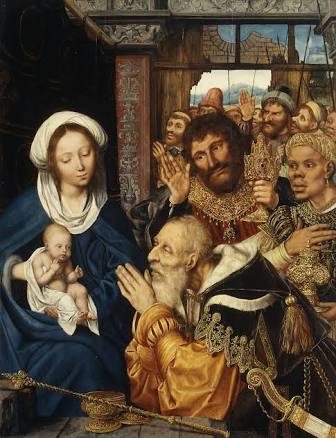
Open thread — topics we haven’t tackled
What topics haven’t we been blogging about on this site that would relate to our niche and make for interesting reading?
My good friend OpinionJournal.com blogger James Taranto drops his insistence that there is no tension between American tolerance and a belief in eternal damnation for wrong-believers (not without getting in one last crude mischaracterization of my argument, however).
Now he says that our disagreement boils down to the following statement of mine, from which he deletes the final clause:
[I]t is an empirical matter, presumably verifiable after the Last Judgment, whether unbelievers and the unbaptised are eternally punished, not just a matter of feeling.
James pretends that I was proposing a scientific test today for what will transpire after death. In fact, I was just stating the obvious: If hell is real, we will all find out–some of us directly–after the Last Judgment. By contrast, the statement which James offers as an analogy to the belief in eternal damnation: “She is the most important thing in the world” is a value judgment that cannot be corroborated by actual experience.
In an effort to be cute, James states that I “must be the only atheist who thinks [that] the Last Judgment is a real event.” Earlier James accused me of lacking imaginative sympathy with religious belief; now he accuses me of believing religious doctrine. I wish he’d make up his mind.
“The reality in the White House is – if you look at the most senior staff – you’re seeing people who aren’t personally religious and have no particular affection for people who are religious-right leaders,” Kuo said.
“In the political affairs shop in particular, you saw a lot of people who just rolled their eyes at … basically every religious-right leader that was out there, because they just found them annoying and insufferable. These guys were pains in the butt who had to be accommodated.”
Note, by contrast or otherwise, DH’s just-preceding post on GWB’s personal beliefs.
Austin Bramwell, He Still Believes:
Bush’s admirers credit him with political courage on par with Lincoln’s. Lincoln, of course, hated the “terrible war” that he felt his duty to wage. “Fondly do we hope,” Lincoln intoned, “fervently do we pray, that this mighty scourge of war may speedily pass away.” Does Bush similarly hate the evils that his policies have caused? It may seem strange that any man should dare to ask the question. Yet according to Bush, the purest test of a leader is the ability to remain an idealist in the face of every calamity. Without the evils that his policies have caused, therefore, Bush could never have made the principled stands that he himself regards as the “big moments” of his presidency. Bush’s idealism, in short, means that he’s not just indifferent to the evil consequences of his actions but positively welcomes them as proofs of his commitment to idealism. In Bush’s mind, the our very failures in Iraq have shown how he has gloriously withstood the test of leadership. For all that other presidents have also claimed the mantle of righteousness, an idealism as fanatical as Bush’s has never been seen before.
One of the main points which my liberal friends have a hard time grasping is the conservative anger at George W. Bush for not being a conservative. Faith and hope are important human traits, and pure rationality leads to a sterile and indecisive existence (as evidenced in António Damásio’s work). But all things in modest measures. One can not know the mind of a man, but on many an occasion I have wondered as to the similarity between the cosmic visions of liberal audacity and George W. Bush’s belief that if he believes it is so, it is so.
The piece that Walter mentioned below makes an interesting assertion:
Christianity, post-Reformation and post-Luther, with its teaching of a direct, personal, two-way link between the individual and God, unmediated by the collective, and unsubordinate to any other human being, smashes straight through the philosphical/spiritual framework I’ve just described. It offers something to hold on to to those anxious to cast off a crushing tribal groupthink. That is why and how it liberates.
This isn’t too surprising a comment from someone of the Anglo-Saxon persuasion; though denigrating “heathen Popery” is no longer in fashion, there is often an implicit assumption that Protestantism superseded Catholicism in the same manner that Christianity supposedly superseded Judaism. But instead of being grounded in soteriology, Protestant superiority impicitly relies a crass Weberian thesis that a shift in specific religious ideas drove social and economic changes more broadly.
A Pew religion survey supports the hypothesis that American tolerance influences theology.
“We are a multicultural society, and people expect this American life to continue the same way in heaven,” [Alan Segal, a professor of religion at Barnard College, commented to to the New York Times.] [I]n our society, we meet so many good people of different faiths that it’s hard for us to imagine God letting them go to hell.
Perhaps it’s not just a “poverty of imagination” that posits a potential tension between secular experience and traditional religious teaching.
Matthew Parris, longtime fixture of center-right British journalism at publications like The Spectator, has been thinking about the intractable problems of Africa:
…I observe that tribal belief is no more peaceable than ours; and that it suppresses individuality. People think collectively; first in terms of the community, extended family and tribe. This rural-traditional mindset feeds into the “big man” and gangster politics of the African city: the exaggerated respect for a swaggering leader, and the (literal) inability to understand the whole idea of loyal opposition….
Christianity, post-Reformation and post-Luther, with its teaching of a direct, personal, two-way link between the individual and God, unmediated by the collective, and unsubordinate to any other human being, smashes straight through the philosophical/spiritual framework I’ve just described. It offers something to hold on to to those anxious to cast off a crushing tribal groupthink. That is why and how it liberates.
Another version of the oft-heard “useful whether or not true” argument? An analogue to what economists sometimes call the “theory of the second best“? Or some third thing?
Gay activists are furiously denouncing the Rick Warren inaugural invitation as an imprimatur for intolerance. At the same time, many in their ranks are trying to destroy the livelihoods not just of indviduals who donated piddling sums to California’s Prop. 8 campaign but of their co-workers as well. This is not necessarily a winning PR strategy.
I just caught a glimpse of the grotesque reality show (a redundancy, I know) “17 Kids and Counting,” which chronicles the “family values” of Arkansas evangelicals Jim Bob and Michelle Duggar and their 17 children. The segment I saw was shot during the final weeks of Michelle’s 18th pregnancy and included discussions of the medical precautions being taken to meet the obstetric challenge presented by a 40+ woman with 17 previous births. The hospital and medical sequence concluded with Jim Bob announcing unctuously: “Ultimately, we’re just putting our faith in God,” or something to that effect.
The heck he is. I would love for once to see someone really put his faith in God and forego the fruits of centuries of patient scientific work based on empirical proof, not faith. Jim Bob cloaks himself in the superior virtue of the pious, and yet his actions in seeking out the best medical advice and care are indistinguishable from a heathen secularist.
One might say, “Well, what’s wrong with a belt-and-suspenders approach? Take advantage of medical science, but it can’t hurt to throw in a little prayer as an extra insurance policy.” What’s wrong is the implication when announcing your prayer policy that you are morally superior to those of us without such a policy, even as you behave (rationally and understandably) just like everyone else.
The baby was delivered safely on December 18. I can guess who will get the ultimate thanks. It’s unlikely to be the unsung generations of empiricists who have triumphed over the childbirth mortality of mothers and infants, a condition that has been the human race’s God-given fate for most of history.
And another guess: in those countries still plagued by high rates of childbirth mortality, parents pray with as much fervor as any Arkansas congregation.
The appeal to unreason as a grounding for religious faith alternates regularly with the appeal to reason as a grounding for religious faith.
That’s very good, Heather. I’ve noticed the same thing. The believers get you coming and going. “It’s not evidence, it’s faith! But there is so evidence!”
And if unreason is a method, how does it lead to this religion rather than that one? Aren’t Vishnu, Thor, Poseidon, Ahura-Mazda, and the Great Manitou all equally unreasonable? How to choose?
According to Wall Street Journal blogger James Taranto, living in modern America, with its easy-going, good-natured inclusiveness, while also believing that your office-mate–who stayed up all night finishing your sales report so you could nurse your sick child–will burn in hell for eternity simply because he is Jewish, is no more puzzling an existential state than feeling that the woman you love is the “most important thing in the world,” while also believing that all men are created equal.
Only someone who suffers from a “poverty of imagination,” writes Taranto, would posit any tension between the lived experience of American tolerance and the knowledge of certain hell for a significant portion of one’s ethical fellow citizens.
With all due respect to my esteemed former City Journal colleague, in my view it may be he who suffers from a poverty of imagination. It cannot be that he is taking the prospect of eternal damnation as seriously as it deserves if he thinks it is so easily reconciled with American openness. I would hope that those who subscribe to the doctrine of divine retribution have struggled a little more than Taranto does with its worldly implications in an era of the rights of man.
Americans have finally created a world in which creedal distinctions are irrelevant to almost all spheres of public and private life. Yet American Christians are to believe that at death, this wonderful ecumenical indifference is yanked away and one’s religion determines whether one has a shot not just at Harvard but at heaven, all thanks to the dispensation of a loving God. If that is not a source of potential cognitive dissonance, I don’t know what is.
Taranto adopts a familiar tactic of religious apologists—the appeal to unreason. “[I]t occurs to us that there are other areas of life that reason alone is inadequate to explain,” he writes. (The appeal to unreason as a grounding for religious faith alternates regularly with the appeal to reason as a grounding for religious faith.) Returning to his analogy between love and eternal damnation, he argues:
“She is the most important thing in the world” makes no sense as a logical proposition, but that does not make it false. Its truth lies elsewhere than in the realm of reason.
I will leave such gobbledygook to those more theologically gifted than I. But let me flesh out Taranto’s analogy.
The statements:
“She is the most important thing in the world” makes no sense as a logical proposition, but that does not make it false. Its truth lies elsewhere than in the realm of reason.
are the same as saying:
“Children who die before being baptised will burn in hell despite possessing equal rights and human worth” makes no sense as a logical proposition, but that does not make it false. Its truth lies elsewhere than in the realm of reason.
James may find this analogy self-evident; I do not. And it is an empirical matter, presumably verifiable after the Last Judgment, whether unbelievers and the unbaptised are eternally punished, not just a matter of feeling.
Pace Taranto, I have not accused Christians of being “insincere or confused.” I hypothesized that because society has changed radically, unrecognizably, since the era when doctrines of eternal damnation were formulated, perhaps the content and experience of religious belief has as well. This is hardly an impious proposition. Ask a believer about Biblical injunctions to stone undevout family members or homosexuals, and you will get a stern lecture about the impropriety of taking such commandments literally in light of evolving faith. Secular, Enlightenment tolerance has revised huge swathes of the Bible; it does not seem so implausible that it could have had a similar if subtler effect on the doctrine of damnation for wrong-believers and the unbaptised. But if it hasn’t, I offer my apologies to all those who are keeping the faith.
P.S. Taranto agrees with me that we should not facilely ascribe bigotry to belief “except on the basis of attitudes toward worldly matters.” Yet he also writes that “[i]t is bigoted to think Jews should not be allowed to . . . live in Hebron, regardless of whether that belief has a theological predicate.” I’m confused. Would it also be bigotry to believe that Palestinians should not live in Hebron?
Just wanted to wish everyone a Merry Christmas. Also, out of curiosity, what’s your favorite Christmas song? I like “Little Drummer Boy.”
I’m almost finished with What Hath God Wrought: The Transformation of America, 1815-1848. Reading this and other books on this period of American history I’m struck by how milquetoast the public discussion of religion is in the political domain today in comparison. I noted below that very few individuals in Congress will admit to not having a religion, and yet I recall John Ashcroft being grilled as to the nature of his adherence to the Assemblies of God during his confirmation hearings. We live in an age when religion is good, just not too much, or too strange. In 1832 Andrew Jackson, arguably the first orthodox Christian president of the early republic, refused to set aside a day of prayer due to his strict separationism. A robust anti-clericalism and secularism was not too uncommon in some sectors of what became the Democratic party. Robust enough that Benjamin Tappan, the irreligious brother of the more famous evangelical Tappans, could win enough favor with the legislature of Ohio to be elected Senator during the period we know as the Second Great Awakening, when evangelical reformist politics were waxing.
Possibly the most annoying explanation for Western Europe’s ‘birth dearth’ is the claim that it is the product of some sort of profound spiritual malaise. Allegedly doomed by their secularism to an endless arid despair, Europeans are, it is sometimes suggested, too consumed with ennui, misery and themselves to bother with reproduction. To describe this argument as nonsense is to insult nonsense.
In fact the decision to have fewer children is simply a by-product of modernity, although ’simply’ is not really the word to use: A fascinating piece by Anthony Gottlieb in the Economist magazine’s Intelligent Life shows us just how complex this topic can be. Most interesting of all, perhaps, is one idea that he cites, the notion that “having families can incline one to religion”. I’m not sure that I buy that (and, wisely, Mr. Gottlieb doesn’t come down on one side of the fence or the other), but, not for the first time, it got me to wondering what (if any) evolutionary function religion might fulfill. That’ll be food for thought for me amid the turkey and mince pies, but in the meantime, merry Christmas, one and all.
Firing off his cap pistol in the enfeebled War against the War on Christmas, Jay Nordlinger, sounding like one of Cal Thomas’s old cardigan sweaters, simpers, “Two seconds ago, ‘Merry Christmas’ was about the warmest, nicest, most joyful thing you could say to someone. Now, it can be borderline hate speech.”
Oh please. Stop with the dearie-me hokum. I was out in the heathen streets of Manhattan yesterday and heard Merry Christmases being exchanged between shoppers, sales staff, pedestrians, parents and children without anybody blowing a whistle for the constable or falling face first in the filthy snow with stricken indignation. I don’t for the life of me understand why certain conservatives seem determined to sprout a bristle tail if somebody wishes them Happy Holidays (instead of M C), acting as if this were a weaselly euphemism meant as a slap in the face of the baby Jesus in the manger. Considering how eerily, bleakly empty so many of the streets and stores were yesterday on the final weekend before Christmas, I suspect shoppers, salespeeps, and store managers alike have larger worries on their minds than which holiday greeting would cause the least abrasion.
I’m all for Merry Christmas, but I do wonder what the reaction would be to widespread use of “Eid Mubarak.”
Recent Comments